

E-Commerce & Software M&A Multiple Update H1/2025
.png)
E-Commerce & Software M&A Multiples Update H1/2025
Cautious Optimism Amid New Trade Headwinds
The first half of 2025 began with promising signs of continued market stabilization, building on the modest recovery seen in 2024. However, newly announced tariffs by the Trump administration have injected a fresh dose of uncertainty into the global M&A landscape, particularly in cross-border e-commerce. Despite this, the broader market response has been more measured than feared - suggesting short-term volatility, but not a fundamental derailment of long-term recovery.
In this update, we take a closer look at the current state of e-commerce and software multiples, market sentiment, and the key valuation benchmarks shaping M&A dynamics in H1 2025.
Amazon- & D2C-Brand Multiples
Amazon remains the dominant platform in e-commerce. Valuations for Amazon-centric brands remained steady compared to the previous year, typically falling within a 1.0x to 4.5x EV/EBITDA range. Well-positioned brands with solid fundamentals are most often valued between 2.0x and 3.0x.
.png)
Buyers continue to favor brands with a strong operational setup, good margins, and defensible niches. While the overall interest has not declined significantly, tariff-related concerns have increased buyer selectivity, particularly for inventory-heavy and import-dependent businesses.
Conversations with several industry insiders clearly indicate that leading Amazon aggregators are increasingly initiating the sale of significant parts of their portfolios. After years of aggressive expansion, strategic consolidation and focus have now moved to the forefront, often accompanied by rising financial pressure. Through our work, we have been able to observe this development firsthand: In recent months, we have supported two such sale processes, giving us direct insight into the current market dynamics. The growing number of prepared transactions underscores that the aggregator segment is entering a phase of active portfolio optimization.
Direct-to-consumer (D2C) brands are also maintaining solid valuation levels, especially those with strong customer retention and efficient acquisition strategies. Most deals are occurring within a 3.5x to 5.5x EV/EBITDA range, though standout brands can reach as high as 7.5x. D2C brands continue to be evaluated with a keen eye on customer loyalty, margin resilience, and CAC efficiency. Despite pressure from rising advertising costs, high-quality D2C brands are still commanding attractive multiples.
A standout example is E.l.f. Beauty’s $1 billion acquisition of Hailey Bieber’s Rhode in May 2025. The DTC-only brand, with just 10 SKUs and $212 million in revenue, achieved a premium valuation highlighting what strategic buyers are willing to pay for culturally relevant, community-driven brands.
The deal included $800 million upfront and a $200 million earnout, reflecting strong confidence in Rhode’s growth.
Marketplaces & SaaS multiples
Note: The following valuations are based on figures from publicly traded marketplaces and SaaS companies, which have been adjusted at a discount to make them applicable to small and mid-cap companies.
Public market sentiment towards marketplaces and SaaS businesses has remained largely stable, with no major corrections since H2 2024.
In the marketplace segment, valuations have edged up slightly since H2 2024. The median EV/revenue multiple now stands at 1.8x, a modest improvement of 0.1x. While this marks a small step in the right direction, it still sits well below the historical average of 5.7x underscoring that investor expectations remain grounded in operational quality and profitability over pure top-line growth.
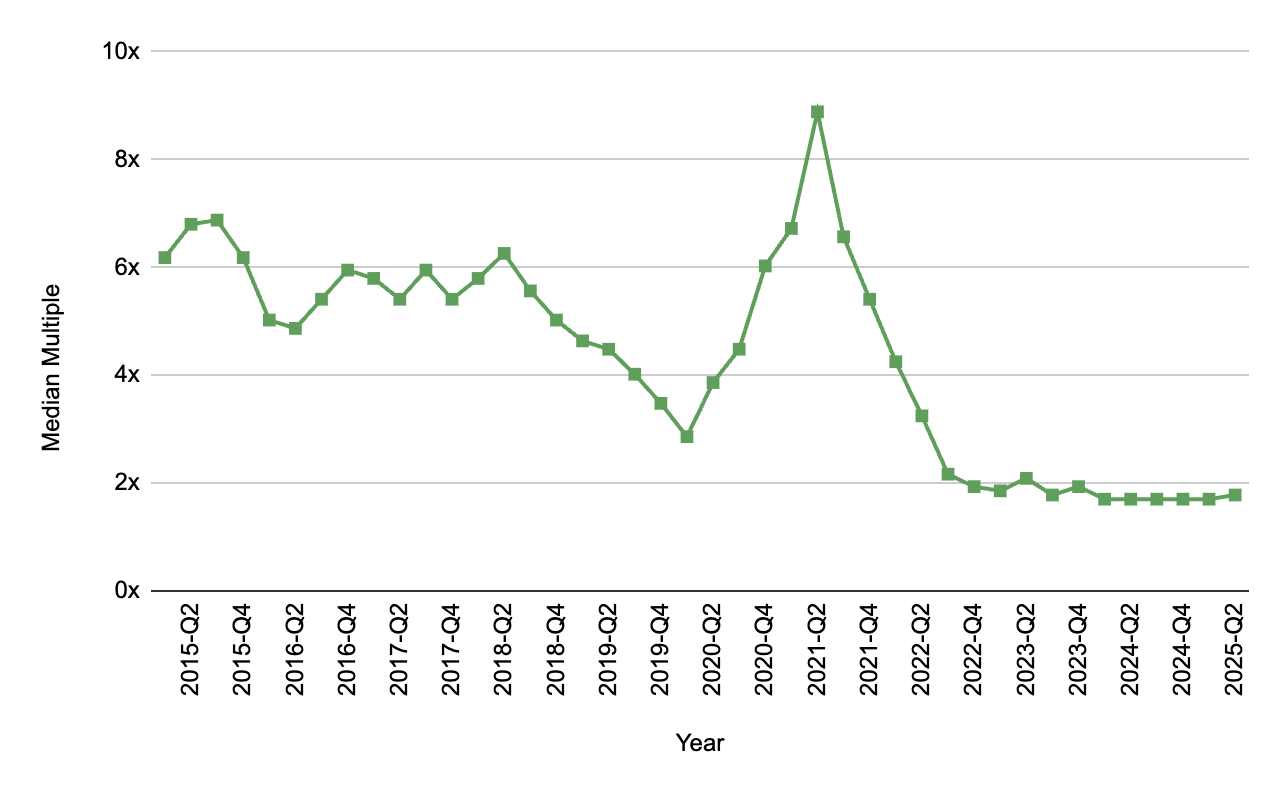
Source: Own presentation based on Aventis Advisors.
.png)
SaaS valuations are gradually rebounding, edging closer to pre-Covid norms as investors refocus on operational efficiency and sustainable growth. The "Rule of 40" has reemerged as a key benchmark, with buyers showing a clear willingness to pay premium multiples for companies that combine double-digit growth with solid margins. Following the steep corrections of recent years, the sector is experiencing a cautious revaluation. The median EV/revenue multiple now stands at 3.3x, signaling a measured but ongoing return to valuation levels last seen around 2016.
AI startups were once again among the most influential drivers of technological innovation in the first half of 2025. In addition to financial investors, strategic buyers are showing growing interest in young companies with clearly differentiated products. The acquisitions of Base44 and Uizard illustrate this trend: both startups impressed with their AI-based solutions in product development and design, attracting the attention of major strategic buyers seeking to strengthen their innovation capabilities through targeted technology acquisitions and to position themselves early for upcoming technological shifts. Uizard and Base44 were ultimately sold successfully to Miro and Wix, respectively, with Base44 achieving an impressive valuation of around USD 80 million. These transactions demonstrate that AI innovation is not only attractive to VCs but is also gaining increasing strategic importance for established companies.
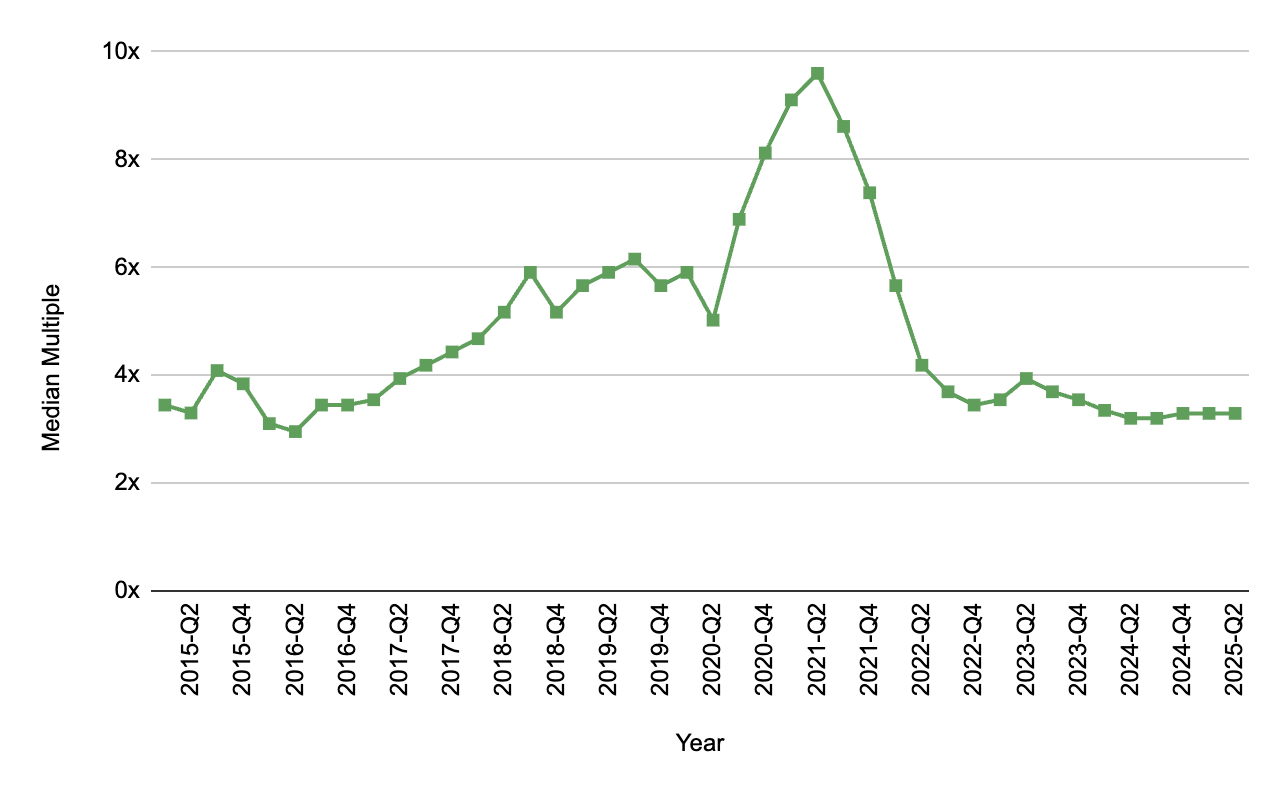
Source: Own presentation based on Aventis Advisors.
General M&A Activity and Market Sentiment
While the tariff announcements initially caused market disruption, transaction activity remained relatively robust in H1 2025 - still cautious and selective.
The overall market sentiment can be described as one of watchful optimism: while investors remain engaged, many are closely monitoring trade policy developments. The recently proposed tariffs from the Trump administration have introduced renewed uncertainty, particularly for internationally exposed sectors. Although there is a broad expectation that these measures may face political resistance and logistical challenges — and thus may not be implemented in full or sustained over time — the near-term impact on corporate decision-making was and partly still is visible. In the M&A space, many buyers have effectively pressed pause, unwilling to commit capital while the cost structures, supply chains, and earnings visibility of target companies remain in flux. That said, capital markets appear to be signaling that the worst of the tariff shock may be behind us, with expectations rising that more measured and negotiable trade terms will ultimately prevail — creating room for deal activity to gradually resume.
At the same time, beyond the immediate noise around tariffs, developments within the e-commerce sector itself are playing a growing role in shaping sentiment. After a period marked by overcapacity and operational inefficiencies, a number of e-commerce businesses have shown tangible signs of stabilization and improvement. Streamlined cost structures and renewed focus on core profitability are helping to rebuild confidence — both among strategic buyers and in capital markets. This shift is creating a more constructive backdrop for deal-making, particularly where operational progress is demonstrable.
This is reflected in several strategic transactions. A notable signal of confidence came from Zalando’s takeover of About You. Ahead of the transaction, About You reported improved performance and met its guidance targets, demonstrating that even in a challenging environment, operational progress and strategic positioning are possible. The transaction also highlights buyer interest in integrated tech platforms, with About You’s B2B SaaS arm playing a key role in the strategic logic of the deal.
Meanwhile, in the marketplace segment, Bike24 delivered one of the strongest Q1 performances in its recent years with growth across all product categories and regions. The company’s early localization efforts and disciplined cost management were met with a positive market response. It’s a clear example of how operational focus, especially in a challenging environment, can restore investor confidence.
Most recently, Mytheresa finalized its acquisition of Yoox Net-a-Porter, forming a new digital luxury group trading under the name LuxExperience. The deal brings together several premium e-commerce banners under one roof and emphasizes operational synergies and platform consolidation as key value drivers. In a market where scale and differentiation matter more than ever, the move is a bold bet on the long-term strength of digital luxury retail.
Together, these three examples reflect a cautiously improving market climate: buyers are active, but focused on profitability, defensibility, and long-term strategic fit. As we head into H2 2025, these developments offer a more optimistic outlook for quality sellers in the e-commerce and software sectors.
Outlook for H2 2025
We maintain a cautiously optimistic view for the second half of 2025. The fundamental drivers of e-commerce and SaaS M&A — digital adoption, automation, and scalable business models — remain intact. At the same time, their full impact continues to be constrained by a challenging macroeconomic backdrop and persistent uncertainty around international trade policy.
Key themes to watch:
- Tariff impact on inventory-heavy D2C and Amazon brands
- Continued premium on profitable growth (especially in SaaS)
- Increased buyer demand for defensible market positions and automation tech
- Opportunities for consolidators as valuation gaps persist
Short-term disruptions are likely, but the long-term trend continues to point toward normalization and recovery - even though with occasional bumps along the way.
Why Us?
To find the right buyer for your company, it is crucial to conduct a targeted analysis of the market environment and valuation multiples - regardless of whether you run an Amazon brand, a D2C brand, a marketplace, or a SaaS company.
How we support you:
Targeted buyer approach through our network
Thanks to our network of Amazon aggregators, private equity investors, and strategic buyers, we understand the purchasing criteria and interests of the relevant players. This enables us to specifically target the right interested parties and enable quick feedback and negotiations through direct contact.
Comprehensive evaluation through market analysis
We conduct a detailed analysis of the relevant valuation multiples and the market environment for your specific business model. Whether it's a D2C brand, marketplace, or SaaS company - we know what's important when it comes to valuation in your industry. With our experience in numerous transactions, we can optimally position your company and highlight its strengths, ensuring that its value and synergies are clearly visible to potential buyers.
Transparent advice without conflicts of interest
Many brokers are well connected, but often have hidden interests that can lead to a suboptimal sale price. We are on your side - with no hidden fees or quick deals at the expense of your goals. Our focus is solely on getting the best deal for you. Our goal is not only to present you with the right buyer but also to ensure a fair and market-based valuation. This way, you get the optimal price for your company and find the right partner who aligns with your strategic goals.
Ready to explore your exit options?
We'd love to have an initial conversation
.svg)

.png)
.png)